OUR BREWERY HERITAGE
BREWING TRADITION IN WESTERHAM SINCE THE EARLY 1600s
Establishment of the Earliest Documented Westerham Brewhouse
The parish burial registers of Westerham record the death of "Michael Hayward - Bruar" in 1608. Hayward’s Will, proved in June of that year, instructed that his "brewehouse with the brewinge vessells" be passed to his sons after his wife's death, providing the earliest direct evidence of commercial brewing in the area.
Foundation of the Malthouse Keystone Origin
The year 1730 was carved into a keystone on a building later used as a boiler house, establishing the claim "Established over 200 years" used on 20th-century beer labels. Historical property deeds reveal the structure originated as part of an 18th-century malthouse owned by Edward Gratwick, which was later run by the Day family before expanding into brewing.
Acquisition of the Bermondsey Black Eagle Premises
Robert Day partnered with Charles Payne and Henry Spike under Day, Payne & Company to purchase a major London brewery in White's Grounds, Bermondsey, for £14,755. Originally built around a 17th-century alehouse named the Black Eagle, this site provided the name for the Westerham operation and allowed the firm to produce dark porters in London and pale ales in Kent.
Construction of the Tower Brewhouse in Westerham
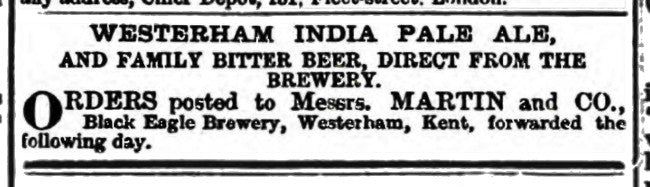
Day, Payne & Company built a large red-brick tower brewhouse in Westerham costing between £10,000 and £15,000 to replace their original, smaller premises. The site was specifically constructed to draw hard water from deep Lower Greensand Ridge aquifers to brew bitter pale ales for the London market.
Growth & The Westerham Railway Line
In 1862 Ben Bushell joined the partnership and for the next 40 years he was to drive the growth in the business. Such was the success of The Black Eagle Brewery that in 1881 a branch line from Sevenoaks to Westerham was constructed to carry beer to and from London. By the turn of the century the brewery was the largest employer in Westerham.
Modification XXX Depth Charges
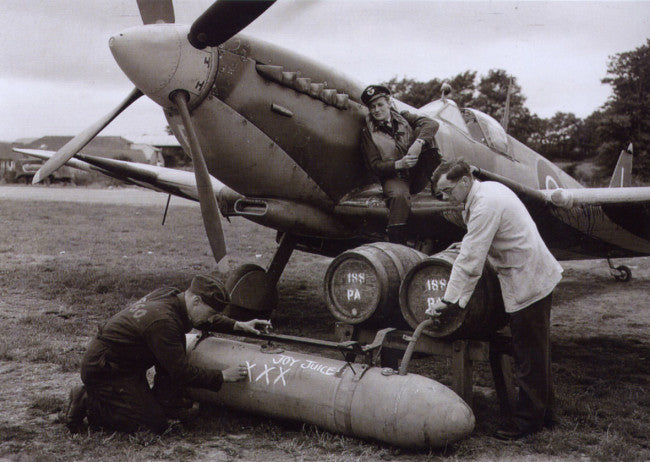
The Second World War could not put a stop to one of Kent’s finest breweries, and Westerham’s ales were popular with young airmen stationed at nearby RAF Biggin Hill. Indeed, following the D-Day landings, Westerham Ales were exported to troops in Normandy inside the auxiliary fuel tanks of Spitfires! They were dubbed “Modification XXX Depth Charges” to get them officially approved for flights.
Auxiliary Fuel Tank Conversions
Black Eagle lorries delivered beer in barrels to Biggin Hill where the auxiliary dual purpose tanks were filled with Bitter on one side and Mild on the other.
“We were also making ‘jettison’, auxiliary fuel tanks for fighter planes to carry extra fuel to enable them to fly further into Europe and still be able to get back home. Once refueling facilities were established over there, the Westerham Brewery used to fill those auxiliary non-returnable petrol tanks with Westerham Ales for our troops in Europe. We made them of 16 gauge metal with baffles for safe landing, the RAF’s version of the brewer’s dray.”
— Edward (Ted) Turner (Brittain’s Engineering in Peckham)
XXX Joy Juice Flown to France
Racking “XXX Joy Juice” into the auxiliary fuel tank of a Spitfire Mark IX. Cask of Westerham Bitter sent to France with the caption reading: “This cask containing Westerham Bitter was flown to France, June 6th 1944 by the Royal Air Force.”
“After D-Day in 1944, there was a problem about getting beer over to the Normandy airfields... So we adapted Spitfire bomb racks so that an 18-gallon (82-litre) barrel could be carried under each wing of the Spitfires... Flight tests proved them to be up to the job. This installation, incidentally, was known as Mod XXX Depth charge.”
— Jeffrey Quill (Spitfire Test Pilot)
Cessation of Production at the Black Eagle Brewery
Head Brewer Bill Wickett mashed the final three barrels of Special Bitter Ale on March 3, 1965, ending over 120 years of production at the site. The property served as an Allied Breweries distribution depot until the mid-1980s before being demolished in 1989 for residential development.
The old brewery site cleared
The old brewery site finally cleared in December after standing empty for years.
Westerham Brewery Established
In June 2004, Robert Wicks established the Westerham Brewery Company at Crockham Hill, resurrecting the historical brand. Wicks recovered original 1950s Black Eagle yeast strains from the National Collection of Yeast Cultures and sourced water from the local greensand aquifer to recreate traditional recipes like Westerham Audit Ale. On March 29, 2017, the company opened a new brewhouse at Beggars Lane in Westerham, mashing its first brew with the revived 1965 Special Bitter Ale.
Westerham Brewery looks to expand
By April 2014 planning consent had been granted to build a completely new brewery and visitorscentre as part of the Westerham Valley development. However, for various reasons work did not commenceuntil the Spring of 2016 and it was hoped at that time that the new brewery would be operational before theend of the year. Unfortunately, this did not prove possible; however, the new Tap Room andretail shop wereopen in time for the Christmas trade.
The new westerham Brew house mashes its first brew
On March 29th 2017, the new Westerham Brewery Company brew house mashed in its first brew. Fittingly, it was 1965 Special Bitter Ale (4.8%abv),which is based upon Bill Wickett’s last brew at the Black Eagle Brewery.Fifty-two years and a few days after Bill had mashed in those three barrelsof his special last brew ‘Westerham Ales’ were brewing in Westerham again!
20th Anniversary of Westerham Brewery
Brewing in Westerham dates back to the early 1600’s. In 1841 Robert Day established The Black Eagle Brewery in Westerham to brew pale bitter ales while he continued to brew Porters in Bermondsey, using London’s softer water.